So, it’s finally out. The Korg Berlin Phase8 has finally started showing up at various stores around the world for pre-order. But what does it sound like? Initially, I saw a number of videos that really focused in on the short, staccato sounds that we’ve already seen. I was perplexed by some of these initial videos.
Fortunately after a couple days, more videos have come out as well as a pretty convincing demo from the Korg Berlin team.
Here are a few facts that I’ve been able to glean from these more recent round of videos:
The entire synth resonates, making it very similar to an acoustic instrument. You can produce and impact sound by touching not just the resonators, but also the side of the synth and even the table next to it.
While the Phase8 is similar to an acoustic instrument, it differs in its ability to use precise controls like envelopes and velocity to shape the sound.
The real-time sequencer offers more versatility than some of the initial videos demonstrated.
When I look at these features collectively, the versatility of the synth comes into focus. It operates, like all real-world instruments, within a set of limits that are meant to be explored, challenged, and resolved. In many ways that’s the point of creative endeavors.
Here are some of the recent videos that I found most helpful in getting a sense of the sound and possibilities for the Phase8:
Rachel from Korg Berlin’s demo really helped me understand the range and performance aspects of the Phase8. Watch this for background and versatility.
Another great video from Noisegate. There’s a great solo exploration of the Phase8 with household objects and an interesting look at pairing it with Teenage Engineering gear.
And finally, Gabe from B&H Pro Audio has a detailed video. Watch for background and experimentation with the Phase8 as part of a set up.
I’m sure more videos will emerge as the Phase8 gets shipped out into the world. I’m really looking forward to seeing more jams and experiments, as I try to figure out if this fits into my setup and music goals.
For the last several months, I’ve been tinkering around with my SP404 MK2 and Arturia Microfreak. While I enjoy both of these things, I felt that I was lacking a drum machine and a dedicated sequencer.
Sure, the SP404 has a sequencer, but it’s just not intuitive for me. I’ve tried it, but it doesn’t click and I find it hard to use and not functional in the way that I imagine other sequencers being helpful. My musical background, as a kid, was in piano and violin. So, while the SP404 is a great beat-maker, I had started to wonder if a more straight-forward grid would help me understand beats and their structures better.
The Microfreak, of course, also has a sequencer. But it can’t sequence multiple tracks or external gear. This is all a matter of perspective of course, but I’ve started to become interested in having what some people call a “brain”.
Pretty quickly, I decided on three possible options:
Arturia Drumbrute Impact
Elektron Model Cycles
Elektron Model Samples
The Drumbrute had the positive of both having a sequencer and working as an analog drum machine with multiple line outs. The freedom here is that I could hook up individual portions of the drum kit to different effects pedals.
The catch is that I don’t yet own any effects pedals. So dry sound or sound going mostly through my SP404 would be my limit at this point. Still, I like the idea of analog drums and the Arturia Drumbrute Impact even seemed to survive the Bad Gear test:
The other contenders for me were the Elektron Model units. Both the Model Cycles and the Model Samples interested me because of their ability to serve a dual purpose of sequencing external gear and performing as a drum machine. Both units also brought the potential to expose me to the much talked about Elektron workflow. Ultimately it was the p-locks and workflow possibilities that led me away from the Drumbrute.
Why Elektron? Why Model vs. “Bigger Boxes?”
First, let me address the choice for going for a Model unit versus just jumping full speed into one of the “bigger boxes” like the Digitone I or II or the Digitakt I or II.
Part of the choice is cost related to me. Of course there are arguments that you can find a used anything for 5 dollars (hell people will pay you to take their used gear if you’re posting on reddit). These exchanges happen somewhere on the internet or out of the trunk of a car at the edge of a parking against the backdrop of a dystopian landscape that somehow blends the aesthetic of Only Lovers Left Alive and Hackers.
Sadly, I like to buy new stuff when talking about complex electronics where a lot can go wrong. Sue me. If it’s broke or messed up I can send it back and get a refund or a new one. It’s a peace of mind issue. I’ve had some luck buying used things that I could try out, but sight unseen? Nope. Burned too many times.
The other reason I considered the Model series is that so many people said they owned a bigger box, but still enjoyed the immediacy and performability of the Model units. I’m still learning how I like to make music and what works for me. So, the Model checked all the boxes:
Drum machine capability
Sequencer with a high level of customization and ability to also sequence external gear
Chance to try out the Elektron workflow in a low risk way
Performability and knob-per-function-like UI
Cycles or Samples?
If you’ve ever considered one of the Model units, the Cycles or the Samples, you’ve probably heard the arguments. But I’ll summarize them here:
Samples is more versatile because it can sound like anything, Cycles just sounds like Cycles.
If you get the Samples, you’ll hit the limitations (namely that you can’t record samples, you can only load them) pretty quickly and just want a Digitakt, so you might as well do the Cycles first.
They’re valid, logical arguments alright. But more than that, they caused me to consider what I already have and where I can see myself going in the future.
Since I already have an SP404 to record and chop and mash up samples, I don’t mind that the Samples can only load samples. I’m primarily, again, interested in having a drum machine and sequencer with the added bonus of trying out the Elektron workflow.
If I fall in love with Elektron, join the online cult and start posting “Buy a Digitakt or Digitone” as my answer to every question I see in an internet forum from How to bake the perfect bread? to Why is my engine light on?, I imagine that I’ll probably get a Digitone II before I would get a Digitakt. This is especially true since I can’t actually tell the clear lines between the Digitakt and the Tonverk. And that’s all assuming that I decide to really shell out, instead of sticking with the smaller and relatively less expensive component approach that I’ve been pursuing so far.
So those are my reasons for buying the Model Samples, which is currently on some kind of infinite back-order. Arrgh! Here’s a couple videos that I found really useful in my journey.
If you have any tips, experiences, counter-logic on the whole selection process, or just want to say “Hi!” Drop a note in the comments.
I’ve been lusting after the Korg Berlin Phase 8. It’s officially a case of GAS (Gear Acquisition Syndrome).
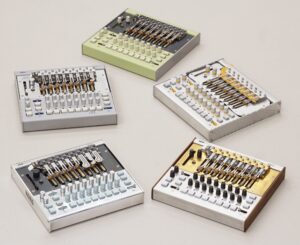
5 Prototypes of the Phase 8 by Korg Berlin.
Have you heard about the Phase 8 from Korg Berlin? A quick search in google will reveal, among other things, a bizarre thread on reddit where someone seems disturbed by the funding structure of Korg. “Why has Korg continued to fund Korg Berlin with basically no output?” writes the poster…perhaps they were under the impression that their tax payer dollars were funding the program?
Either way, the fact that this discussion is at the top of the search results highlights the scarcity of information out there. Here’s what I know:
What does the Korg Berlin Phase 8 do?
The Phase 8 is an 8 voice acoustic synthesis synthesizer that generates sound by electromagnetically striking resonators. The goal is to blend physical vibration with synthesis. I’ve heard people on the internet describe this as a hybrid sound of piano and kalimba, but I’ve also more recently heard some sounds that seem more diverse and potentially deeper coming out of very short Instagram stories.
In addition to the way it makes sound, the unit also has a sequencer that can be polyrhythmic and it “may” be possible to swap out the resonators. When you look at the photo above or visit the Korg Berlin website to listen to the sound demos created by staff at Korg Berlin, you’ll probably notice the wide variation in color schemes and customization.
Will these variations in look as well as resonator type be available in the mass produced units? I hope so. Otherwise it would seem like a bit of a mistake to create awesome prototypes that only give the impression that the mass produced units are lesser or more vanilla.
How does the Korg Berlin Phase 8 sound?
As I mentioned there are a few videos available on the website, but also there are some demos on YouTube. I’d recommend this one:
Is it just a potentially expensive Kalimba? I doubt it, I think Korg Berlin has kept information and sound demos very close to their chest. Some of the newer videos emerging on Instagram stories (and sadly disappearing as fast as they come) hint at a very large sonic range. I’m hoping that turns out to be the case.
When & How Much?
The unit is supposed to come out in the first quarter (which for non-office drones or accounts means January to March of 2026). And it’s supposed to cost under 1000 Euro (1,163 USD). How that fits into the European and North American cost of living crisis which has become equally a cost of synthesis crisis, I don’t know.
The price is stiff to be sure, but not unbearable for a piece of gear that could become central in a setup. And that’s the question, will this be the kind of unit that we’re willing to save for and to pass up other options to buy?
I think my reaction to this will very much depend on the depth and breadth of sound we see once longer and more in-depth videos and sound demos emerge. For now, the GAS is still building.
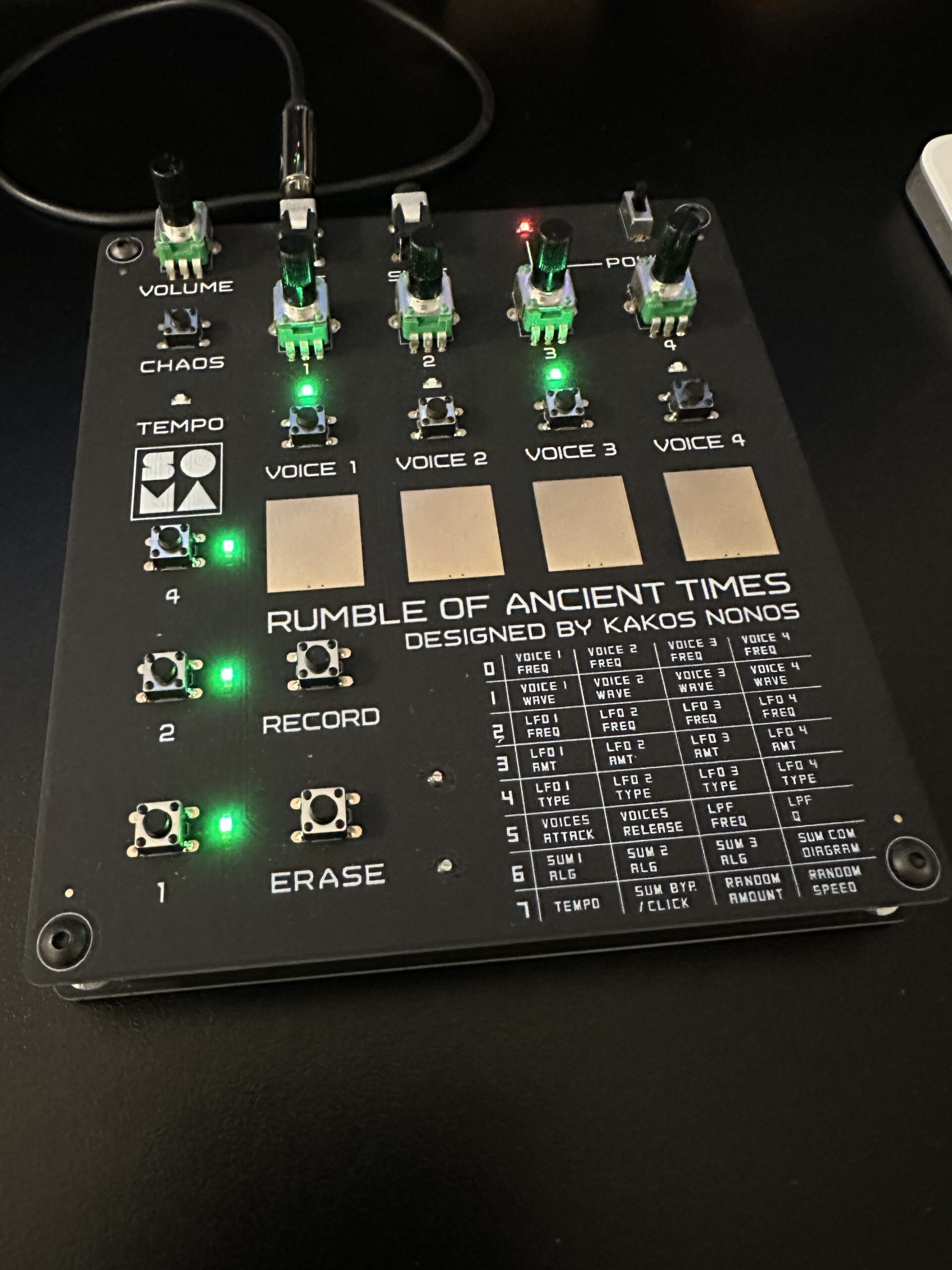
Recently, I got a Rumble of Ancient Times by SOMA. It’s an interesting synth. All of the things made by SOMA are intriguing, the ROAT just happens to be the most accessible at the moment.
I love little synths and hardware tools, but something I read about the ROAT really attracted my attention.
We live in an age where text editors can be 1GB or more and simple things like checking email require the latest OS and powerful processing, despite the core tasks being no different than 15 years ago with a fraction of the computational power.
I love this kind of thinking and it made me think a little bit about the connection between ecology and the hardware instruments that we use. On the sound front, I took longer to decide.
To be honest, most of the videos that I had seen were of harsh and unstructured noise. Not that I dislike that, but I was curious about the range of ROAT. So, I decided that I would create 30 short videos exploring the ROAT. Below is the first of 30 and you’ll be able to see others on my YouTube channel: Hammer_and_Circuit.