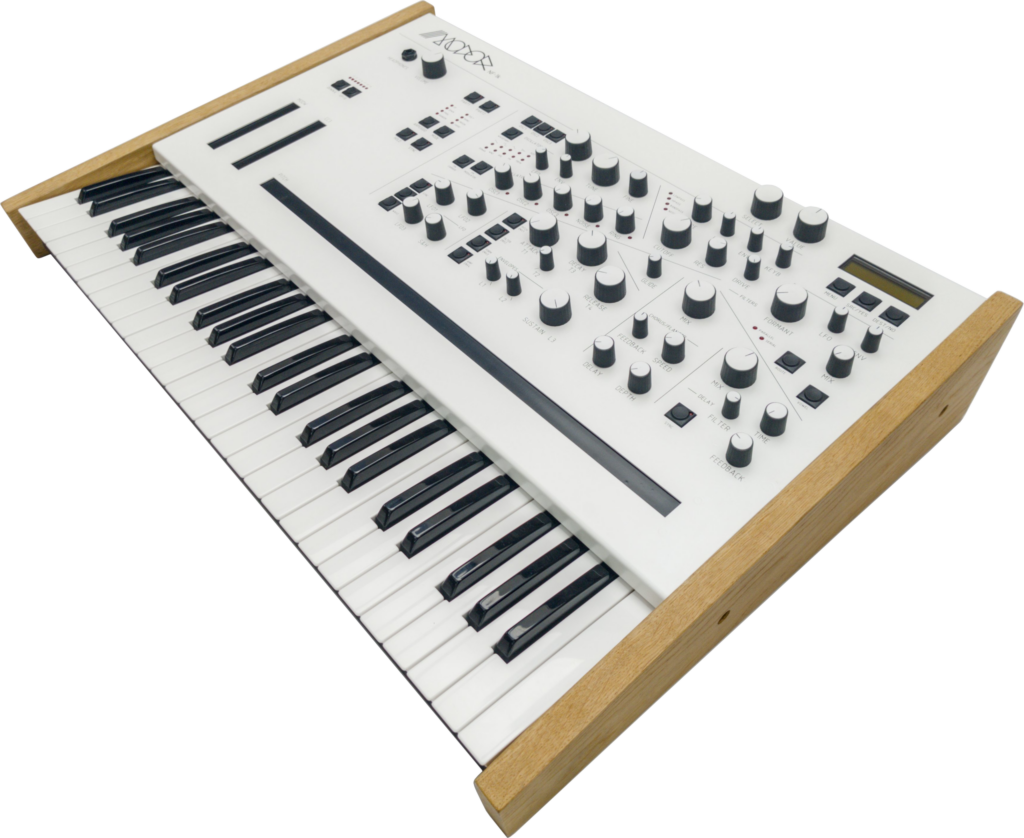
Modor is a boutique Belgian hardware synth company run by Marcel Belmans. And their new release, the NF-1k builds on the success and coolness of their NF-1 digital polyphonic synthesizer.
So, what’s different about the NF-1k?
For one thing, it has a 49-key weighted Fatar keyboard. These Italian-made keyboards set a high standard for feel and weight that gives synths like the Take 5 and Prophet series as luxurious feel. This is real instrument feel territory.
But the Modor NF-1k isn’t just an NF-1 with a premium keyboard. It also has several new features that impact the sound. The newly developed voice board ups to polyphony to 16 voices and makes the Modor NF-1k a 2-part multitimbral synth.
This means that essentially two NF-1s can be layered, split over the keyboard or sequenced independently. They’ve also added an arpeggiator, chord mode, and hold. Added to this is a unison mode that allows for detuning and stereo spread.
Another cool feature of both the NF-1 and the Modor NF-1k is the ability of these units to be programmed for micro-tonal playing.
Here’s a short promotional video of the Modor NF-1k. While I think it’s a nice start, I have always craved longer, more in-depth videos of their synths. Perhaps something similar to the Bo Beats video on the DR-2 drum machine.
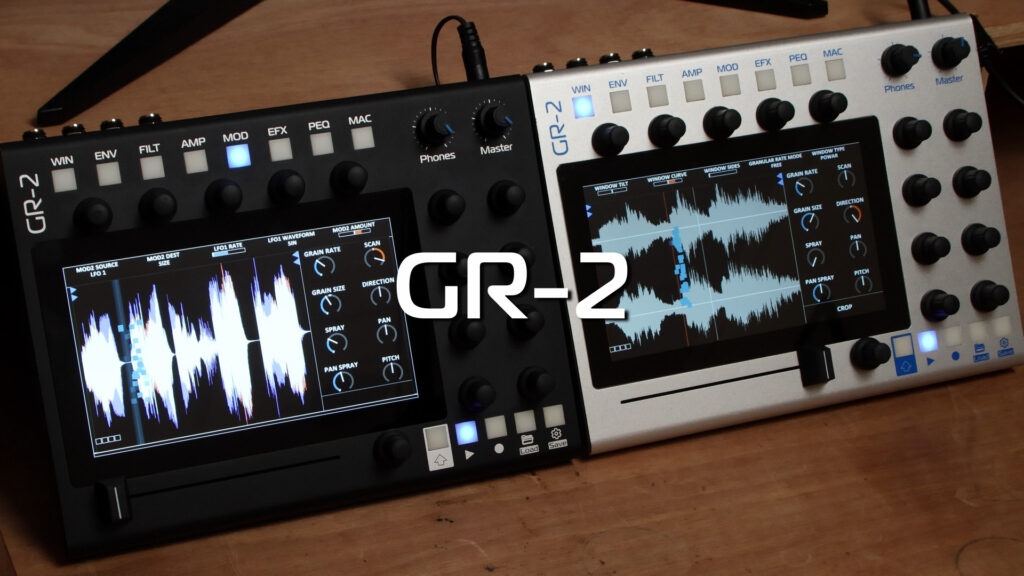
Tasty Chips has been producing some of the most interesting and exciting granular synthesis and sampling hardware units in the last couple of years. Now they’ve presented a Kickstarter campaign featuring the GR2. Is this simply an updated GR-1 with a touch screen or does it cross into territory previously dominated by the GR MEGA? What’s the real difference between the Tasty Chips GR MEGA and the GR2?
Enter the GR2
Like so many other interesting Kickstarter projects, the GR2 pledge period has come and gone. At least the initial development. But don’t worry, if you missed these 100 units, they’re only the early bird units and a little (or a lot) of patience is all you’ll need to have a crack at owning one yourself. Look at it as time to save up the money (which at the time of the Kickstarter campaign was 849 Euros).
What is the GR2 and what does it do? Described as the sequel to the GR-1, the GR2 is smaller and also features an impressive touch screen. However, in a dispatch from the mailing list, it is actually the GR MEGA that has been referenced most, not the larger, older GR-1.
GR MEGA, the big boss!
The GR Mega is without a doubt an impressive granular synthesis. Bo Beats calls it the final boss of granular synth and his video is definitely one of the best ones out there if you’re looking to get a sense of the functionality and possibilities of the GR MEGA.
One thing that’s been announced since Bo Beat’s video, is that multi-sampling functionality has been scheduled for a future update. That really continues to build the GR MEGA as not just a great granular synth, but a really impressive and complete instrument for sampling.
So, is the GR2 an updated, touch-screen enabled, more portable GR MEGA for less than half the price?
What’s the difference between Tasty Chips GR MEGA and GR2?
While there aren’t many live demos out there to get a really good sense of how the GR MEGA and GR2 stack up, some obvious differences and considerations can help you distinguish the two.
Let’s talk touchscreen. Not everybody loves a touch screen. In fact, that’s an oft cited downside of some of the MPCs. The GR MEGA does not have a touch screen and seems like the amount of menu diving is less than what may be the case with the GR2.
Tasty Chips goes on to add, “The GR-2 has somewhat lower polyphony, lacks the amount of function-specific knobs and buttons, and lacks luxury interfaces like HDMI and balanced audio.”
While the UI and connectivity are clearly points of departure for the two units, Tasty Chips argues that in the long-run, the shared root functionality will benefit those who have purchased the GR MEGA through improved features, further firmware releases brought on by GR2 feedback, and an expanding patch library.
So which unit feels right to you? Are you a GR MEGA owner? Drop your thoughts in the comments!
So, it’s finally out. The Korg Berlin Phase8 has finally started showing up at various stores around the world for pre-order. But what does it sound like? Initially, I saw a number of videos that really focused in on the short, staccato sounds that we’ve already seen. I was perplexed by some of these initial videos.
Fortunately after a couple days, more videos have come out as well as a pretty convincing demo from the Korg Berlin team.
Here are a few facts that I’ve been able to glean from these more recent round of videos:
The entire synth resonates, making it very similar to an acoustic instrument. You can produce and impact sound by touching not just the resonators, but also the side of the synth and even the table next to it.
While the Phase8 is similar to an acoustic instrument, it differs in its ability to use precise controls like envelopes and velocity to shape the sound.
The real-time sequencer offers more versatility than some of the initial videos demonstrated.
When I look at these features collectively, the versatility of the synth comes into focus. It operates, like all real-world instruments, within a set of limits that are meant to be explored, challenged, and resolved. In many ways that’s the point of creative endeavors.
Here are some of the recent videos that I found most helpful in getting a sense of the sound and possibilities for the Phase8:
Rachel from Korg Berlin’s demo really helped me understand the range and performance aspects of the Phase8. Watch this for background and versatility.
Another great video from Noisegate. There’s a great solo exploration of the Phase8 with household objects and an interesting look at pairing it with Teenage Engineering gear.
And finally, Gabe from B&H Pro Audio has a detailed video. Watch for background and experimentation with the Phase8 as part of a set up.
I’m sure more videos will emerge as the Phase8 gets shipped out into the world. I’m really looking forward to seeing more jams and experiments, as I try to figure out if this fits into my setup and music goals.
I’ve been lusting after the Korg Berlin Phase 8. It’s officially a case of GAS (Gear Acquisition Syndrome).
5 Prototypes of the Phase 8 by Korg Berlin.
Have you heard about the Phase 8 from Korg Berlin? A quick search in google will reveal, among other things, a bizarre thread on reddit where someone seems disturbed by the funding structure of Korg. “Why has Korg continued to fund Korg Berlin with basically no output?” writes the poster…perhaps they were under the impression that their tax payer dollars were funding the program?
Either way, the fact that this discussion is at the top of the search results highlights the scarcity of information out there. Here’s what I know:
What does the Korg Berlin Phase 8 do?
The Phase 8 is an 8 voice acoustic synthesis synthesizer that generates sound by electromagnetically striking resonators. The goal is to blend physical vibration with synthesis. I’ve heard people on the internet describe this as a hybrid sound of piano and kalimba, but I’ve also more recently heard some sounds that seem more diverse and potentially deeper coming out of very short Instagram stories.
In addition to the way it makes sound, the unit also has a sequencer that can be polyrhythmic and it “may” be possible to swap out the resonators. When you look at the photo above or visit the Korg Berlin website to listen to the sound demos created by staff at Korg Berlin, you’ll probably notice the wide variation in color schemes and customization.
Will these variations in look as well as resonator type be available in the mass produced units? I hope so. Otherwise it would seem like a bit of a mistake to create awesome prototypes that only give the impression that the mass produced units are lesser or more vanilla.
How does the Korg Berlin Phase 8 sound?
As I mentioned there are a few videos available on the website, but also there are some demos on YouTube. I’d recommend this one:
Is it just a potentially expensive Kalimba? I doubt it, I think Korg Berlin has kept information and sound demos very close to their chest. Some of the newer videos emerging on Instagram stories (and sadly disappearing as fast as they come) hint at a very large sonic range. I’m hoping that turns out to be the case.
When & How Much?
The unit is supposed to come out in the first quarter (which for non-office drones or accounts means January to March of 2026). And it’s supposed to cost under 1000 Euro (1,163 USD). How that fits into the European and North American cost of living crisis which has become equally a cost of synthesis crisis, I don’t know.
The price is stiff to be sure, but not unbearable for a piece of gear that could become central in a setup. And that’s the question, will this be the kind of unit that we’re willing to save for and to pass up other options to buy?
I think my reaction to this will very much depend on the depth and breadth of sound we see once longer and more in-depth videos and sound demos emerge. For now, the GAS is still building.
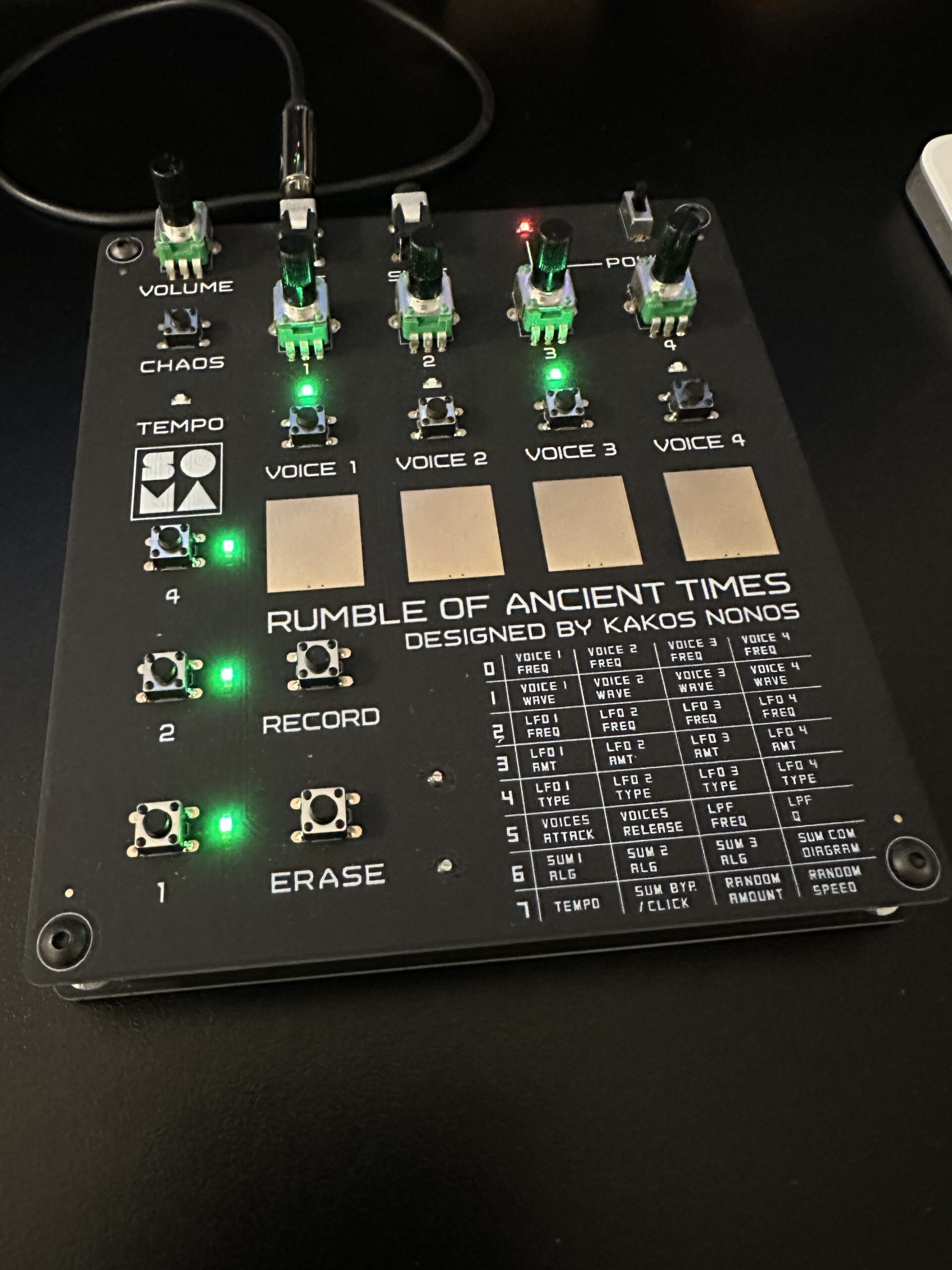
Recently, I got a Rumble of Ancient Times by SOMA. It’s an interesting synth. All of the things made by SOMA are intriguing, the ROAT just happens to be the most accessible at the moment.
I love little synths and hardware tools, but something I read about the ROAT really attracted my attention.
We live in an age where text editors can be 1GB or more and simple things like checking email require the latest OS and powerful processing, despite the core tasks being no different than 15 years ago with a fraction of the computational power.
I love this kind of thinking and it made me think a little bit about the connection between ecology and the hardware instruments that we use. On the sound front, I took longer to decide.
To be honest, most of the videos that I had seen were of harsh and unstructured noise. Not that I dislike that, but I was curious about the range of ROAT. So, I decided that I would create 30 short videos exploring the ROAT. Below is the first of 30 and you’ll be able to see others on my YouTube channel: Hammer_and_Circuit.